
펩타이드 및 나노소재 기반 약물 방출 콘택트렌즈의 연구 동향과 치료·진단 융합 가능성에 관한 고찰

초록
본 연구는 기존 점안제의 낮은 안구 표면 체류시간, 낮은 생체이용률 및 반복 점안에 따른 순응도 저하 문제를 보완하기 위한 대안으로 주목받는 약물 방출 콘택트렌즈(drug-eluting contact lenses, DECLs)의 연구 동향을 고찰하고, 펩타이드·나노소재 기반 기능화, 생체반응형 방출 및 치료·진단 융합형 theranostic 플랫폼으로의 발전 가능성을 제시하고자 하였다. 본 연구는 녹내장을 주요 만성 안과 질환 사례로 포함하되, 건성안, 알레르기 결막염, 감염성 각막염, 각막 신생혈관 및 전안부 염증 등 다양한 안과 질환 적용 가능성을 함께 다루었다.
PubMed, Web of Science, Scopus 및 Google Scholar를 활용하여 2014년 1월부터 2025년 9월까지 발표된 관련 문헌을 검토하였다. 검색어는 drug-eluting contact lens, drug-loaded contact lens, ocular drug delivery, nanoparticle contact lens, peptide/peptoid contact lens, molecular imprinting, supercritical CO2 contact lens, ROS-responsive contact lens, theranostic lens, smartphone colorimetry 등을 조합하였다. 콘택트렌즈 기반 약물전달, 항균 표면 기능화 또는 센싱과 직접 관련된 원저 및 주요 리뷰를 포함하였고, 질환 모델, 약물 종류, 렌즈 소재, 방출시험 조건 및 평가지표의 이질성이 커 정량적 메타분석은 수행하지 않았다.
총 349편의 문헌이 검색되었고, 중복 제거, 제목·초록 검토 및 원문 검토를 거쳐 최종 32편을 분석에 포함하였다. 약물 방출 콘택트렌즈는 soaking, embedding, nanocarrier incorporation, surface coating, molecular imprinting, supercritical CO2 infusion 등 다양한 약물 탑재 전략을 통해 방출 지속성을 개선해 왔다. Hydrogel, silicone hydrogel, biodegradable polymer, nanocarrier-laden lens, peptide/peptoid-functionalized surface 등은 적용 질환과 약물 특성에 따라 서로 다른 장점과 한계를 보였다. ROS-responsive contact lens는 전임상 염증 및 손상 모델에서 보고되었으나, 장기 안전성, 반복 착용 시 재현성 및 임상 검증은 아직 제한적이다. 스마트폰 기반 색 정량화는 CIELAB/ΔE 분석을 넘어 색상 카드 보정, 영상처리 파이프라인 및 동적 영상 색 보정으로 발전하고 있으나, 콘택트렌즈 기반 눈물 바이오마커 측정에서의 임상 검증은 추가 연구가 필요하다.
약물 방출 콘택트렌즈는 안구 표면 약물 체류시간을 늘리고 반복 점안 부담을 줄일 수 있는 차세대 안과 치료 플랫폼이다. 향후 치료·진단 융합형 콘택트렌즈로 발전하기 위해서는 생체지표 반응형 방출, 센서 보정 및 표준화, 광학적 투명도와 산소투과도 보존, 장기 임상시험, 국제 표준 및 규제 가이드라인 정립이 필요하다.
Abstract
This review summarizes recent advances in peptide- and nanomaterial-based drug-eluting contact lenses (DECLs) as alternatives to conventional eye drops, focusing on sustained drug delivery, bioresponsive release, antimicrobial surface functionalization, and therapeutic–diagnostic convergence. Glaucoma is discussed as a major chronic ocular indication, but the scope also includes dry eye disease, ocular allergy, infectious keratitis, corneal neovascularization, and anterior-segment inflammation.
A structured narrative/scoping review was conducted with reference to the PRISMA 2020 framework. PubMed, Web of Science, Scopus, and Google Scholar were searched for studies published from January 2014 to September 2025. Search terms included drug-eluting contact lens, drug-loaded contact lens, ocular drug delivery, nanoparticle contact lens, peptide or peptoid contact lens, molecular imprinting, supercritical CO2 contact lens, ROS-responsive contact lens, theranostic lens, and smartphone colorimetry. Original articles and reviews directly related to contact lens-based drug delivery, antimicrobial surface functionalization, or sensing were included.
A total of 349 records were found, and 32 studies were finally included after duplicate removal, title/abstract screening, and full-text assessment. Soaking, embedding, nanocarrier incorporation, coating, molecular imprinting, and supercritical CO2 infusion have been investigated to improve drug loading and sustained release. Hydrogels, silicone hydrogels(including silicone hydrogels), nanocarrier-loaded lenses, and peptide/peptoid-functionalized surfaces showed different advantages and limitations according to disease indication and intended function. ROS-responsive contact lenses have been reported in preclinical ocular inflammation and injury models; however, long-term safety, reproducibility, and clinical validation remain limited. Smartphone-based colorimetric analysis and correction algorithms suggest the feasibility of remote monitoring, but clinical validation in contact lens-based tear biomarker assessment remains insufficient.
DECLs represent the next-generation ocular therapeutic platform that may improve ocular drug residence time, dosing convenience, and patient adherence. Their evolution toward theranostic contact lenses will require bioresponsive release mechanisms, robust sensor calibration, preservation of optical and oxygen-transmission properties, long-term clinical evidence, and harmonized regulatory standards.
Keywords:
Drug-eluting contact lenses, Peptide, Nanomaterials, Bioresponsive drug delivery키워드:
약물 방출 콘택트렌즈, 펩타이드, 나노소재, 생체반응형 약물전달서 론
녹내장은 전 세계적으로 비가역적 시기능 손상을 유발하는 주요 안과 질환 중 하나이며, 환자 수는 지속적으로 증가하고 있다. Tham 등[1]은 2013년 전 세계 녹내장 환자 수를 약 6,430만 명으로 추정하였고, 2040년에는 1억 1,180만 명에 이를 것으로 예측하였다. Zhang 등[2]은 primary open-angle glaucoma(POAG)의 전 세계 유병률을 2.4%로 보고하였으며, Ehrlich 등[3]은 2022년 미국 성인의 1.62% 가 녹내장을 가지고 있다고 보고하였다. 이러한 역학적 부담은 장기간 약물치료와 환자 순응도가 중요한 만성 안과 질환에서 새로운 약물전달 플랫폼의 필요성을 보여준다.
그러나 약물 방출 콘택트렌즈의 임상적 적용 가능성은 녹내장에만 국한되지 않는다. 건성안, 알레르기 결막염, 감염성 각막염, 각막 신생혈관, 각막 및 전안부 염증, 수술 후 염증 조절 등 다양한 안과 질환에서 콘택트렌즈 기반 약물전달 또는 기능성 표면 설계가 연구되어 왔다[4-8]. 따라서 본 연구에서 녹내장은 약물 방출 콘택트렌즈의 대표적 만성 치료 적용 사례로 제시되며, 본 논문의 범위는 약물 방출 콘택트렌즈 전반의 기술적 진전과 치료·진단 융합 가능성을 포괄한다.
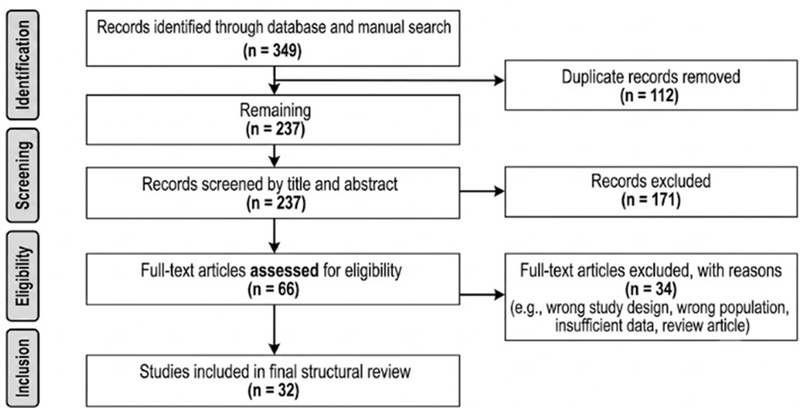
PRISMA 2020 flowchart for the literature selection process.
기존 점안제는 눈물, 깜박임, 누액 배출 및 비루관 배출에 의해 약물이 빠르게 제거되며, 실제 안구 조직에 도달하는 비율은 낮은 것으로 알려져 있다[4,5]. 이러한 짧은 안구 표면 체류시간은 치료 농도를 유지하기 위한 반복 점안을 요구하고, 반복 투약 부담과 사용법 오류는 장기 치료가 필요한 환자의 순응도 저하로 이어질 수 있다[4,5]. 콘택트렌즈는 각막 전면 및 후렌즈 눈물층(post-lens tear film)에 약물을 비교적 오래 머물게 하여 약물 체류시간을 연장하고, 점안제보다 지속적인 약물 전달을 가능하게 하는 장점을 가진다[4,5].
약물 방출 콘택트렌즈의 개발에는 soaking, embedding, coating, molecular imprinting, nanocarrier incorporation, supercritical CO2 infusion 등 다양한 전략이 활용되어 왔다[4-7,9,10]. 초기 soaking 방식은 단순하고 저비용이라는 장점이 있으나 급격한 초기 burst release가 발생하기 쉽다. 반면 나노입자, 리포좀, 마이셀, 다층 코팅, 분자각인 및 반응형 소재는 약물 안정성, 방출 지속성, 표적성 또는 온디맨드 방출 조절 가능성을 높일 수 있다[5-7,9-20].
한편 스마트 콘택트렌즈 연구는 약물전달을 넘어 센서, 통신, 전원 및 데이터 처리 기술을 통합하는 방향으로 발전하고 있다[8,21]. 특히 CIELAB 색공간과 ΔE(ΔE00)를 활용한 색 정량화, 색상 카드 기반 보정, 스마트폰 앱 및 영상처리 기반 보정 알고리즘은 원격 모니터링과 point-of-care 분석 가능성을 높이고 있다[22-26]. 그러나 눈물 성분, 콘택트렌즈 착용에 따른 생체지표 변화, 촬영 조명과 각도, 기기별 카메라 차이를 임상 수준으로 표준화하는 문제는 여전히 해결해야 할 과제이다[8,22-27].
본 연구의 목적은 녹내장을 포함한 다양한 안과 질환에서 펩타이드 및 나노소재 기반 약물 방출 콘택트렌즈의 개발 동향을 정리하고, 약물 탑재 및 방출 전략, 소재 특성, 항균 펩타이드/펩토이드 표면 기능화, 생체반응형 방출 및 치료·진단 융합 가능성을 종합적으로 고찰하는 것이다. 본 연구는 정량적 메타분석을 목표로 한 체계적 문헌고찰이 아니라, 기술 발전의 흐름과 연구 공백을 파악하기 위한 PRISMA 2020을 참고한 구조화된 서술적/범위 문헌고찰로 수행되었다.
방법
본 연구는 약물 방출 콘택트렌즈의 기술 발전과 치료·진단 융합 가능성을 정리하기 위한 구조화된 서술적/범위 문헌고찰로 수행하였다. 문헌 검색과 선정 과정은 PRISMA 2020 흐름을 참고하여 정리하였다. PubMed, Web of Science, Scopus 및 Google Scholar를 활용하여 2014년 1월부터 2025년 9월까지 발표된 문헌을 대상으로 검색하였다. 단, 고전적 개념 또는 특정 기술의 근거를 설명하는 데 필요한 경우에는 2014년 이전의 핵심 문헌도 제한적으로 참고하였다.
검색어는 “drug-eluting contact lens”, “drug-loaded contact lens”, “therapeutic contact lens”, “ocular drug delivery”, “nanoparticle contact lens”, “liposome contact lens”, “micelle contact lens”, “molecular imprinting contact lens”, “supercritical CO2 contact lens”, “ROS-responsive contact lens”, “peptide contact lens”, “peptoid contact lens”, “theranostic contact lens”, “smart contact lens”, “smartphone colorimetry”, “CIELAB”, “ΔE” 등을 조합하였다. 검색 전략의 재현성을 높이기 위해 주요 검색식은 Table 1에 제시하였다(Table 1).

Example literature search strategy
문헌 선정 기준은 다음과 같다(Table 2). 포함 기준은 (1) 콘택트렌즈 기반 약물전달, 항균 표면 기능화 또는 센싱 기술을 직접 다룬 원저 또는 리뷰, (2) 안과 질환 적용 가능성이 명확한 연구, (3) 약물 탑재 방식, 방출 특성, 소재 물성, 나노소재 또는 펩타이드/펩토이드 표면 기능화, 스마트 센싱 또는 치료·진단 융합과 관련된 연구로 하였다. 제외 기준은 (1) 콘택트렌즈와 직접 관련이 없는 일반 안과 약물전달 연구, (2) 학위논문, 초록만 제공되는 문헌, 중복 보고, (3) 소재 또는 약물 방출 특성에 대한 정보가 불충분한 문헌, (4) 본 연구 주제와 관련성이 낮은 단순 임상·기기 보고로 하였다.
Inclusion and exclusion criteria
자료 추출 항목은 저자 및 연도, 연구 유형, 적용 질환 또는 모델, 렌즈 소재, 약물 또는 기능성 물질, 탑재·방출 전략, 방출 기간 또는 주요 성능, 광학적 투명도·산소투과도 등 렌즈 물성, 생체적합성 또는 독성 평가, 주요 한계로 설정하였다. 포함 문헌의 질환, 약물, 소재, 평가 지표 및 연구 설계가 매우 이질적이어서 정량적 메타분석은 수행하지 않았으며, 연구 간 이질성과 근거 수준은 결과 및 고찰에서 질적으로 평가하였다.
결과 및 고찰
본 연구에서는 PubMed, Web of Science, Scopus 및 Google Scholar를 통해 2014년 1월부터 2025년 9월까지 발표된 관련 문헌을 검색하였다. 검색 결과 총 349편의 문헌이 확인되었으며, 이 중 중복 문헌 112편을 제외한 237편을 제목 및 초록 검토 대상으로 하였다. 제목과 초록 검토 단계에서 본 연구 주제와 직접 관련성이 낮은 문헌 171편을 제외하였고, 남은 66편에 대해 원문 검토를 수행하였다. 원문 검토 단계에서는 콘택트렌즈 기반 약물전달 또는 센싱과 직접 관련성이 낮은 문헌, 소재·방출 특성이 불명확한 문헌, 단순 제품·기기 소개 성격의 문헌 등을 제외하였다. 최종적으로 본 연구의 선정 기준에 부합하는 32편의 문헌을 분석에 포함하였다.
1. 약물 탑재 및 방출 전략
선정된 문헌에서 약물 방출 콘택트렌즈의 약물 탑재 방식은 soaking, embedding, nanocarrier incorporation, surface coating, molecular imprinting, supercritical CO2 infusion 등으로 구분되었다. Soaking 방식은 제조가 간단하고 다양한 약물에 적용할 수 있다는 장점이 있으나, 약물이 렌즈 매트릭스 내부에 안정적으로 고정되지 않아 초기 burst release가 발생하기 쉽고 지속 방출 시간이 제한되는 한계가 있었다[4,5]. Embedding 방식은 약물을 렌즈 제조 과정에서 고분자 매트릭스에 직접 포함시키는 방식으로, 약물 분포와 방출 조절 측면에서 장점이 있으나 렌즈의 투명도, 산소투과도 및 기계적 물성 저하 가능성이 함께 고려되어야 한다[7]. Nanocarrier incorporation 방식은 나노입자, 리포좀, 마이셀 등을 렌즈 내부 또는 표면에 결합하여 약물 안정성과 방출 지속성을 향상시키는 전략이다[9]. 이 방식은 친수성 및 소수성 약물 모두에 적용 가능성이 있으며, 복수 약물의 병합 전달에도 활용될 수 있다. 다만 나노소재의 농도와 분산 상태에 따라 렌즈 투명도와 산소투과도가 저하될 수 있어, 약물 방출 성능과 렌즈 물성 사이의 균형이 중요하다[7,9]. Surface coating과 molecular imprinting은 방출 프로파일을 정밀하게 조절하거나 특정 약물에 대한 선택적 결합 부위를 형성할 수 있는 장점이 있으나, 제조 공정의 복잡성과 대량 생산 가능성은 여전히 검토가 필요하다[5,6]. Supercritical CO2 infusion은 비교적 균일한 약물 주입이 가능하고 유기용매 사용을 줄일 수 있는 방법으로 제시되었으며, 최근 항균·항진균 약물 주입 콘택트렌즈 연구에서도 활용 가능성이 보고되었다[10](Table 3).
Comparison of drug loading and release methods in contact lenses
2. 주요 소재 및 약물 방출 특성
약물 방출 콘택트렌즈의 소재는 hydrogel/silicone hydrogel, biodegradable polymer, nanomaterial-composite lens, peptide/peptoid-functionalized surface로 구분할 수 있다. Hydrogel과 silicone hydrogel은 높은 수분 함량, 광학적 투명도 및 생체적합성으로 인해 가장 널리 활용되는 소재군이다[4,5]. 특히 silicone hydrogel은 산소투과도 측면에서 장점이 있으나, 약물의 친수성·소수성 특성, 고분자 매트릭스와의 상호작용, 표면 습윤성 유지가 함께 고려되어야 한다. 단순 soaking 방식만으로는 친수성 약물의 급격한 초기 방출과 소수성 약물의 낮은 적재량 문제가 발생할 수 있다[4,5].
Biodegradable polymer는 분해 속도를 조절하여 장기 방출을 설계할 수 있다는 장점이 있으며, PLA, PLGA, chitosan, gelatin 등이 연구되어 왔다[11]. 이러한 소재는 체내 분해 가능성과 생체적합성 측면에서 장점이 있으나, 콘택트렌즈 형태로 적용할 경우 광학적 투명도, 기계적 안정성, 착용감, 제조 재현성 확보가 필요하다. Nanomaterial-composite lens는 나노입자, 리포좀, 마이셀, 그래핀옥사이드, 자성입자 등을 활용하여 약물 안정성, 방출 지속성 및 복합 기능성을 부여하는 전략이다[9,12]. 그러나 나노소재의 고농도 적용은 렌즈 투명도와 산소투과도 저하, 장기 독성, 규제 검증 문제를 유발할 수 있으므로 약물 방출 성능뿐 아니라 광학적·생리학적 안전성 평가가 병행되어야 한다[7,9].
펩타이드 및 펩토이드 기반 표면 기능화는 약물 방출 시스템이라기보다 항균 표면 설계에 가까운 연구 축으로 해석할 수 있다. 항균 펩타이드 또는 펩토이드를 렌즈 표면에 고정화할 경우 Pseudomonas aeruginosa 및 Staphylococcus aureus와 같은 콘택트렌즈 관련 감염균의 부착과 biofilm 형성을 억제할 수 있는 가능성이 보고되었다[31,32]. 이러한 접근은 감염성 각막염 예방과 항균 기능성 렌즈 개발 측면에서 의미가 있으나, 약물 방출형 나노캐리어 시스템과는 작용 방식이 다르므로 별도의 표면 기능화 전략으로 구분하는 것이 타당하다(Table 4).
Material properties of drug-eluting contact lenses
3. 나노소재 및 생체반응형 융합 연구
나노입자, 리포좀 및 마이셀은 약물의 렌즈 내 체류시간을 연장하고 방출 지속성을 향상시키는 데 활용되어 왔다[9]. 예를 들어 chitosan nanoparticle-laden contact lens는 timolol maleate의 효소 반응형 조절 방출을 통해 보관 중 약물 손실을 줄이고 장시간 안압 저하 가능성을 제시한 것으로 보고되었다[15]. 또한 supercritical CO2를 이용한 moxifloxacin 및 amphotericin B 주입 콘택트렌즈는 세균성 및 진균성 각막염 치료를 위한 장기 방출 플랫폼으로 활용 가능성이 제시되었다[10].
자기장을 이용한 온디맨드 방출 전략도 보고되었다. Wang과 Park은 외부 자기장에 의해 구동되는 마이크로펌프를 콘택트렌즈에 내장하여 체크밸브를 개폐함으로써 약물 방출을 제어하는 방식을 제시하였다[12]. 이 접근은 착용형 렌즈에서 약물 방출량을 외부 자극으로 조절할 수 있다는 가능성을 보여주지만, 실제 임상 적용을 위해서는 렌즈 투명도, 착용 안전성, 전원 또는 구동 시스템의 소형화, 장기 생체적합성 검증이 필요하다.
기존 원고에서 ROS 증가에 연동된 약물 방출을 “연구 공백”으로 표현한 부분은 최신 문헌을 반영하여 수정하였다. ROS-responsive contact lens는 2023년 corneal neovascularization 모델에서 dexamethasone의 H2O2-responsive release와 in vivo 효능이 보고되었고[13], 2024년에는 levofloxacin과 diclofenac을 ROS 수준에 따라 동시 방출하는 adaptive drug-releasing contact lens가 bacterial keratitis 및 alkali burn 모델에서 보고되었다[14]. 따라서 현재는 “완전한 연구 공백”이라기보다 “전임상 단계의 초기 연구가 보고되었으나, 장기 안전성, 반복 착용 시 방출 재현성, 사람 대상 임상 검증이 부족한 영역”으로 해석하는 것이 타당하다.
4. 치료·진단 융합 가능성
스마트 콘택트렌즈 연구는 센서, 통신, 전원, 약물전달 기능을 통합하는 방향으로 발전하고 있다[8,21]. 특히 녹내장 분야에서는 intraocular pressure(IOP) 모니터링과 약물 방출 기능을 결합하려는 시도가 이루어지고 있으며, 스마트 콘택트렌즈는 단순 시력교정 기기를 넘어 질환 모니터링 및 치료 플랫폼으로 확장될 가능성을 가진다[8,21].
Optical quantification은 스마트폰 카메라로 촬영한 이미지를 CIELAB 색공간으로 변환하고 ΔE 또는 ΔE00을 계산하여 색 변화를 정량화하는 방식으로 활용되어 왔다[22-24]. 최근 연구는 단순한 색공간 변환을 넘어 색상 카드 기반 보정, 영상처리 파이프라인, 기기 간 편차 보정 및 동적 영상 기반 색 보정으로 발전하고 있다. Menon 등은 HueDx color correction system을 이용하여 스마트폰 기반 paper-based total protein assay의 정량 성능을 개선할 수 있음을 보고하였고[22], Meng 등은 색 보정 알고리즘을 적용한 스마트폰 기반 colorimetric detection platform을 통해 조명 조건과 스마트폰 모델 차이에 따른 외부 간섭을 줄일 수 있음을 제시하였다[23]. Fyfe 등은 스마트폰 기반 동적 색 분석에서 color reference chart를 이용한 matrix-based correction이 기기 및 조명 의존 변동을 감소시킬 수 있음을 보고하였다[24].
다만 이러한 색 정량화 기술의 발전이 곧바로 콘택트렌즈 기반 임상 진단의 완성도를 의미하는 것은 아니다. 콘택트렌즈 착용 자체가 눈물 내 cytokine 농도와 표면 침착에 영향을 줄 수 있고[27], 눈물량, 촬영 각도, 조명, 스마트폰 기종, 렌즈 표면의 단백질·지질 침착 및 분석 알고리즘 차이가 결과에 영향을 미칠 수 있다[22-24,27]. 따라서 치료·진단 융합형 콘택트렌즈의 임상 적용을 위해서는 표준화된 촬영 조건, 보정 알고리즘, 눈물 바이오마커 기준치, 렌즈 착용에 따른 생체지표 교란 보정이 필요하다(Table 5).
Research gaps in therapeutic-diagnostic contact lens development
5. 고찰
본 연구는 펩타이드 및 나노소재 기반 약물 방출 콘택트렌즈의 연구 동향을 약물 탑재 및 방출 전략, 소재 특성, 나노소재 및 생체반응형 융합, 치료·진단 융합 가능성으로 구분하여 검토하였다. 전반적으로 약물 방출 콘택트렌즈는 기존 점안제의 낮은 안구 표면 체류시간과 낮은 생체이용률을 보완하기 위한 대안으로 연구되어 왔으며, 단순 soaking 방식에서 벗어나 나노입자, 리포좀, 마이셀, 다층 코팅, 분자각인, supercritical CO2 infusion 등 다양한 전략으로 확장되고 있다[4-7,9,10,15].
첫째, 약물 방출 콘택트렌즈의 핵심 과제는 방출 지속성 개선과 렌즈 물성 유지 사이의 균형이다. 약물 방출 기간을 늘리기 위해 나노소재나 고분자 코팅층을 적용하면 약물 안정성은 향상될 수 있으나, 고농도 적용 시 렌즈 투명도, 산소투과도, 표면 습윤성 및 착용감이 저하될 수 있다[7,9]. 따라서 약물 방출 성능만을 기준으로 플랫폼을 평가하기보다는 광학적 투명도, 산소투과도, 함수율, 기계적 강도, 생체적합성 및 멸균·보관 안정성을 함께 평가해야 한다.
둘째, 펩타이드 및 펩토이드 기반 기능화는 제목의 범위와 연결되는 중요한 보완 요소이다. 기존 약물 방출 콘택트렌즈 연구가 주로 약물 적재와 방출 조절에 초점을 맞추었다면, 항균 펩타이드 또는 펩토이드 표면 기능화는 콘택트렌즈 관련 감염 위험을 줄이기 위한 항균 표면 설계로 해석할 수 있다[31,32]. 이는 감염성 각막염 예방 또는 항균 기능성 렌즈 개발과 관련성이 있으나, 약물이 렌즈에서 지속적으로 방출되는 시스템과는 구분된다. 따라서 본 연구에서는 펩타이드/펩토이드 기능화를 약물 방출 전략의 하위 유형으로 단순 포함하기보다, 항균 표면 기능화 및 감염 예방 전략으로 별도 논의하였다.
셋째, 생체반응형 방출 시스템은 향후 치료·진단 융합형 콘택트렌즈로 발전하기 위한 핵심 기술이다. ROS-responsive contact lens 연구는 최근 전임상 모델에서 보고되기 시작했으며[13,14], 이는 기존의 단순 서방형 방출에서 질환 미세환경에 반응하는 adaptive drug release로 발전할 가능성을 보여준다. 그러나 현재까지는 주로 in vitro 또는 동물모델 단계에 머물러 있으며, 사람 대상 장기 착용 안전성, 반복 착용 시 방출 재현성, 멸균 후 성능 유지, 보관 안정성 및 임상 유효성 검증은 제한적이다. 따라서 “연구 공백”이라는 표현보다는 “초기 전임상 연구는 보고되었으나 임상 근거가 부족한 영역”으로 기술하는 것이 사실 기반의 표현에 가깝다.
넷째, 치료·진단 융합형 theranostic contact lens의 구현을 위해서는 센싱 결과와 약물 방출 기능이 단순히 한 렌즈에 병렬적으로 배치되는 수준을 넘어, 질환 관련 생체지표 측정 결과가 약물 방출 조절 또는 임상 의사결정과 연결되는 폐루프형 플랫폼으로 발전해야 한다. 현재 스마트 콘택트렌즈는 IOP, glucose, lactate, cytokine 등 다양한 지표의 측정 가능성을 보여주고 있으며[8,21,27], 스마트폰 기반 colorimetric analysis와 보정 알고리즘은 원격 모니터링 가능성을 높이고 있다[21-26]. 그러나 눈물 생체지표는 개인차, 시간대, 렌즈 착용 여부, 눈물량, 염증 상태 및 촬영 조건에 영향을 받을 수 있으므로, 임상적 의사결정에 활용하기 위해서는 표준화된 측정 프로토콜과 보정 알고리즘이 필요하다[22-24,27].
다섯째, 포함된 연구들은 질환 모델, 약물 종류, 렌즈 소재, 방출시험 조건, 평가 지표 및 연구 설계가 매우 이질적이었다. 일부 연구는 static in vitro release test를 사용한 반면, 다른 연구는 tear-flow simulator, 세포 독성 평가, 동물 질환 모델 또는 초기 임상 착용 평가를 사용하였다. 이러한 차이는 특정 방출 기간이나 치료 효과를 모든 약물 방출 콘택트렌즈에 일반화하는 것을 어렵게 만든다. 따라서 본 연구에서는 정량적 메타분석을 수행하지 않고, 연구 설계와 평가 지표의 차이를 고려한 구조화된 서술적·범위 문헌고찰 방식으로 결과를 정리하였다.
마지막으로 상용화와 임상 적용을 위해서는 국제 표준 및 규제 가이드라인을 고려한 검증 체계가 필요하다. 약물 방출 콘택트렌즈는 광학기기, 의료기기, 약물전달 시스템의 성격을 동시에 가지므로, 렌즈 물성 평가, 생체적합성 평가, 장기 착용 안전성, 멸균·보관 안정성, 약물 방출 재현성 및 센서 성능 평가를 통합적으로 검토해야 한다. 특히 ISO 18369-3은 콘택트렌즈의 물리적·광학적 특성 측정과 관련된 기준으로 활용될 수 있으며[39], ISO 10993 및 FDA 생체적합성 관련 가이던스는 인체 접촉 의료기기 평가 시 고려해야 할 중요한 규제적 기준이 될 수 있다[40](Table 6).
Technical and translational trade-offs in drug-eluting contact lenses
결 론
약물 방출 콘택트렌즈는 기존 점안제의 낮은 안구 표면 체류시간, 낮은 생체이용률 및 반복 점안에 따른 환자 순응도 저하 문제를 보완할 수 있는 차세대 안과 약물전달 플랫폼이다. 본 연구는 녹내장을 주요 만성 안과 질환 사례로 포함하되, 건성안, 알레르기 결막염, 감염성 각막염, 각막 신생혈관 및 전안부 염증 등 다양한 안과 질환에서의 적용 가능성을 함께 검토하였다.
현재까지 약물 방출 콘택트렌즈 연구는 단순 soaking 방식에서 나노입자, 리포좀, 마이셀, 다층 코팅, 분자각인, supercritical CO2 infusion, 펩타이드/펩토이드 표면 기능화 및 ROS-responsive release 등으로 확장되고 있다. 이러한 접근은 약물 체류시간 연장, 방출 지속성 개선, 항균 기능 부여, 생체반응형 방출 및 치료·진단 융합 가능성을 보여준다. 특히 ROS-responsive contact lens는 더 이상 완전한 연구 공백으로 보기 어렵고, 전임상 단계에서 초기 연구가 보고된 영역으로 해석하는 것이 타당하다.
그러나 장기 착용 안전성, 반복 착용 시 방출 재현성, 광학적 투명도와 산소투과도 유지, 멸균·보관 안정성, 사람 대상 임상 검증은 여전히 제한적이다. 또한 치료·진단 융합형 theranostic contact lens로 발전하기 위해서는 약물 방출 기능과 센싱 기능을 단순히 결합하는 수준을 넘어, 질병 관련 생체지표를 안정적으로 측정하고 그 결과가 약물 방출 조절 또는 임상 의사결정과 연결되는 플랫폼으로 발전해야 한다.
향후 연구에서는 생체지표 반응형 방출 시스템, 장기 임상시험, 표준화된 센서 보정 알고리즘, 눈물 바이오마커 기준치 확립, 렌즈 물성 및 생체적합성 평가, 국제 표준과 규제 가이드라인을 고려한 검증 체계가 필요하다. 이를 통해 펩타이드 및 나노소재 기반 약물 방출 콘택트렌즈는 단순한 안과 약물전달 플랫폼을 넘어, 개인 맞춤형 치료와 질환 모니터링을 동시에 수행할 수 있는 치료·진단 융합형 스마트 콘택트렌즈로 발전할 수 있을 것으로 판단된다.
References
-
Tham YC, Li X, Wong TY, Quigley HA, Aung T, Cheng CY. Global prevalence of glaucoma and projections of glaucoma burden through 2040: A systematic review and meta-analysis. Ophthalmology. 2014;121(11):2081-2090.
[https://doi.org/10.1016/j.ophtha.2014.05.013]

-
Zhang N, Wang J, Li Y, Jiang B. Prevalence of primary open angle glaucoma in the last 20 years: A meta-analysis and systematic review. Sci Rep. 2021;11:13762.
[https://doi.org/10.1038/s41598-021-92971-w]
-
Ehrlich JR, Burke-Conte Z, Wittenborn JS, Saaddine J, Omura JD, et al. Prevalence of glaucoma among US adults in 2022. JAMA Ophthalmol. 2024;142(11):1041-1050.
[https://doi.org/10.1001/jamaophthalmol.2024.3884]
-
Rykowska I, Nowak I, Nowak R. Soft contact lenses as drug delivery systems: A review. Molecules. 2021;26(18):5577.
[https://doi.org/10.3390/molecules26185577]
-
Franco P, De Marco I. Contact lenses as ophthalmic drug delivery systems: A review. Polymers (Basel). 2021;13(7):1102.
[https://doi.org/10.3390/polym13071102]
-
Zhao L, Song J, Du Y, Guo L, Wang Y, et al. Therapeutic applications of contact lens-based drug delivery systems in ophthalmic diseases. Drug Deliv. 2023;30(1):2219419.
[https://doi.org/10.1080/10717544.2023.2219419]
-
Rykowska I, Michałkiewicz O, Nowak I, Nowak R. Drug-modified contact lenses—Properties, release kinetics, and stability of active substances with particular emphasis on cyclosporine A: A review. Molecules. 2024;29(11):2609.
[https://doi.org/10.3390/molecules29112609]
-
Ioniță M, Vlăsceanu GM, Toader A, Manole M. Advances in therapeutic contact lenses for the management of different ocular conditions. J Pers Med. 2023;13(11):1571.
[https://doi.org/10.3390/jpm13111571]
-
Baghban R, Talebnejad MR, Meshksar A, Heydari M, Khalili MR, et al. Recent advancements in nanomaterial-laden contact lenses for diagnosis and treatment of glaucoma, review and update. J Nanobiotechnol. 2023;21:402.
[https://doi.org/10.1186/s12951-023-02166-w]
-
Gungor B, Erdogan H, Suner SS, Silan C, Saraydin SU, Sahiner N. Drug-impregnated contact lenses via supercritical carbon dioxide: A viable solution for the treatment of bacterial and fungal keratitis. Int J Pharm. 2024;662:124505.
[https://doi.org/10.1016/j.ijpharm.2024.124505]
-
Rykowska I, Nowak I, Nowak R, Michałkiewicz O. Biodegradable contact lenses for targeted ocular drug delivery: Recent advances, clinical applications, and translational perspectives. Molecules. 2025;30(12):2542.
[https://doi.org/10.3390/molecules30122542]
-
Wang C, Park J. Magnetic micropump embedded in contact lens for on-demand drug delivery. Micro Nano Syst Lett. 2020;8:1.
[https://doi.org/10.1186/s40486-019-0101-x]
-
Sun R, Ma S, Chen X, et al. Inflammation-responsive molecular-gated contact lens for the treatment of corneal neovascularization. J Control Release. 2023;360:818-830.
[https://doi.org/10.1016/j.jconrel.2023.07.036]
-
Sun R, Zhang J, Chen X, et al. An adaptive drug-releasing contact lens for personalized treatment of ocular infections and injuries. J Control Release. 2024;369:114-127.
[https://doi.org/10.1016/j.jconrel.2024.03.040]
-
Maulvi FA, Patel AR, Shetty KH, Desai DT, Shah DO, Willcox MDP. Chitosan nanoparticles laden contact lenses for enzyme-triggered controlled delivery of timolol maleate: A promising strategy for managing glaucoma. Drug Deliv Transl Res. 2024;14:3212-3224.
[https://doi.org/10.1007/s13346-024-01543-8]
-
Chauhan A, et al. Ocular drug delivery via contact lenses. J Control Release. 2014;185:134-145.
[https://doi.org/10.1016/j.jconrel.2014.04.020]
-
Byrne ME, et al. Molecularly imprinted polymers for biomimetic contact lenses. J Biomater Sci Polym Ed. 2015;26(17):1199-1215.
[https://doi.org/10.1080/09205063.2015.1084224]
-
Kapoor Y, et al. Liposome-incorporated contact lenses for sustained ophthalmic drug delivery. Int J Pharm. 2017;522(1-2):41-52.
[https://doi.org/10.1016/j.ijpharm.2017.02.061]
-
Bengani LC, et al. Contact lenses with a polymer film for 1-month drug delivery. Biomaterials. 2019;190:64-75.
[https://doi.org/10.1016/j.biomaterials.2018.10.021]
-
Horne E, et al. Antimicrobial peptoid coatings for contact lenses. Biomacromolecules. 2023;24(5):2210-2221.
[https://doi.org/10.1021/acs.biomac.3c00084]
-
Wu KY, Dave A, Carbonneau M, Tran SD. Smart contact lenses in ophthalmology: Innovations, applications, and future prospects. Micromachines (Basel). 2024;15(7):856.
[https://doi.org/10.3390/mi15070856]
-
Menon N, Beery D, Sharma P, et al. Development of a smartphone enabled, paper-based quantitative diagnostic assay using the HueDx color correction system. PLoS One. 2024;19(10):e0311343.
[https://doi.org/10.1371/journal.pone.0311343]
-
Meng R, Yu Z, Fu Q, et al. Smartphone-based colorimetric detection platform using color correction algorithms to reduce external interference. Spectrochim Acta A Mol Biomol Spectrosc. 2024;316:124350.
[https://doi.org/10.1016/j.saa.2024.124350]
-
Fyfe C, Yu S, Zhang J, Reid M. RGB color correction and gamut limitations in smartphone-based kinetic analysis of chemical reactions. Anal Bioanal Chem. 2025;417:5753-5770.
[https://doi.org/10.1007/s00216-025-06021-9]
-
Zhang J, et al. Smartphone-based tear fluid analysis using smart contact lenses. Biosensors. 2024;14(2):98.
[https://doi.org/10.3390/bios14020098]
-
Alexeev VL, et al. High-finesse optical sensors based on polymer hydrogels. Anal Chem. 2014;86(4):2113-2121.
[https://doi.org/10.1021/ac4036252]
- Willcox MDP, Zhao Z, Naduvilath T, et al. Cytokine changes in tears and relationship to contact lens discomfort. Mol Vis. 2015;21:293-304.
-
Mun J, et al. Graphene oxide-modified contact lenses for glaucoma treatment. ACS Appl Mater Interfaces. 2023;15(8):10432-10444.
[https://doi.org/10.1021/acsami.2c21214]
-
Silva D, et al. Supercritical fluid technology for drug loading in contact lenses. J Supercrit Fluids. 2022;182:105520.
[https://doi.org/10.1016/j.supflu.2022.105520]
-
Garcia-Fernandez MJ, et al. Supercritical CO2 assisted loading of dexamethasone into hydrogel lenses. J Pharm Sci. 2021;110(7):2754-2763.
[https://doi.org/10.1016/j.xphs.2021.03.012]
-
Salvagni E, García C, Manresa À, et al. Short and ultra-short antimicrobial peptides anchored onto soft commercial contact lenses inhibit bacterial adhesion. Colloids Surf B Biointerfaces. 2020;196:111283.
[https://doi.org/10.1016/j.colsurfb.2020.111283]
-
Sara M, Chakraborty S, Chen R, et al. The effect of immobilisation strategies on the ability of peptoids to reduce the adhesion of P. aeruginosa strains to contact lenses. Exp Eye Res. 2025;250:110149.
[https://doi.org/10.1016/j.exer.2024.110149]
-
Alvarez-Lorenzo C, et al. Soft contact lenses for controlled drug delivery. Gels. 2016;2(4):28.
[https://doi.org/10.3390/gels2040028]
-
Radomsky C, et al. Sustained release of timolol from silicone hydrogel lenses. Invest Ophthalmol Vis Sci. 2018;59(3):1214-1223.
[https://doi.org/10.1167/iovs.17-23421]
-
Toffoletto G, et al. Bioresponsive contact lenses for corneal wound healing. Acta Biomater. 2020;114:145-156.
[https://doi.org/10.1016/j.actbio.2020.07.030]
-
Phan CM, et al. Peptide-functionalized contact lenses for anti-fungal applications. Biosens Bioelectron. 2022;201:113942.
[https://doi.org/10.1016/j.bios.2021.113942]
-
Choi SW, Park J, Kim J, et al. Therapeutic contact lens for scavenging excessive reactive oxygen species. ACS Nano. 2020;14(6):7185-7196.
[https://doi.org/10.1021/acsnano.9b10145]
-
Lee S, et al. Wireless smart contact lens for diagnostic and therapeutic applications. Sci Adv. 2022;8(17):eabm9385.
[https://doi.org/10.1126/sciadv.abm9385]
- International Organization for Standardization. ISO 18369-3:2017. Ophthalmic optics—Contact lenses—Part 3: Measurement methods. Geneva: ISO; 2017.
- U.S. Food and Drug Administration. Use of International Standard ISO 10993-1, “Biological evaluation of medical devices—Part 1: Evaluation and testing within a risk management process”: Guidance for Industry and Food and Drug Administration Staff. Silver Spring, MD: FDA; 2023.
-
Kim J, et al. Extended delivery of ophthalmic drugs from a smart contact lens. Biomaterials. 2021;275:120924.
[https://doi.org/10.1016/j.biomaterials.2021.120924]